Ocarina of Time
Late this July there was a piece of gaming news: an independent developer used OpenAI’s Codex to port The Legend of Zelda: Ocarina of Time natively to the iPhone and iPad. The original on the N64 ran at 240p and about 20 frames per second; the phone version is widescreen and runs at 60. The source code he used came from the player community, and anyone who wants to play has to supply their own ROM.
Chinese-language communities have this kind of thing too. I’ve seen someone port Diablo II to iOS, and I’ve seen people piece games together with AI.
There’s a Chinese project on GitHub called sts2-ios that ports Slay the Spire 2 natively to the iPhone. The most important file in the repository is written for AI to read. It’s called AGENTS.md, and the README introduces it as “a deterministic runbook that goes from environment checks, filling in config, one-command build, all the way to signing and installing. Follow it and the game lands on your iPhone.” The part of the work that takes knowing how to compile and sign is handed off to coding assistants like Claude Code and Cursor.
People tend to assume there are giant corporations standing behind AI: they hold the compute, the capital and the data, they’ll control everything, and in the end they’ll build a cyberpunk society. That picture isn’t wrong, but only half of it has been painted.
I’ve come to feel that AI is a golden age for pirates, and a golden age for fan creators too. The really interesting things are happening at the giants’ feet. What I want to say comes down, more or less, to the picture below.
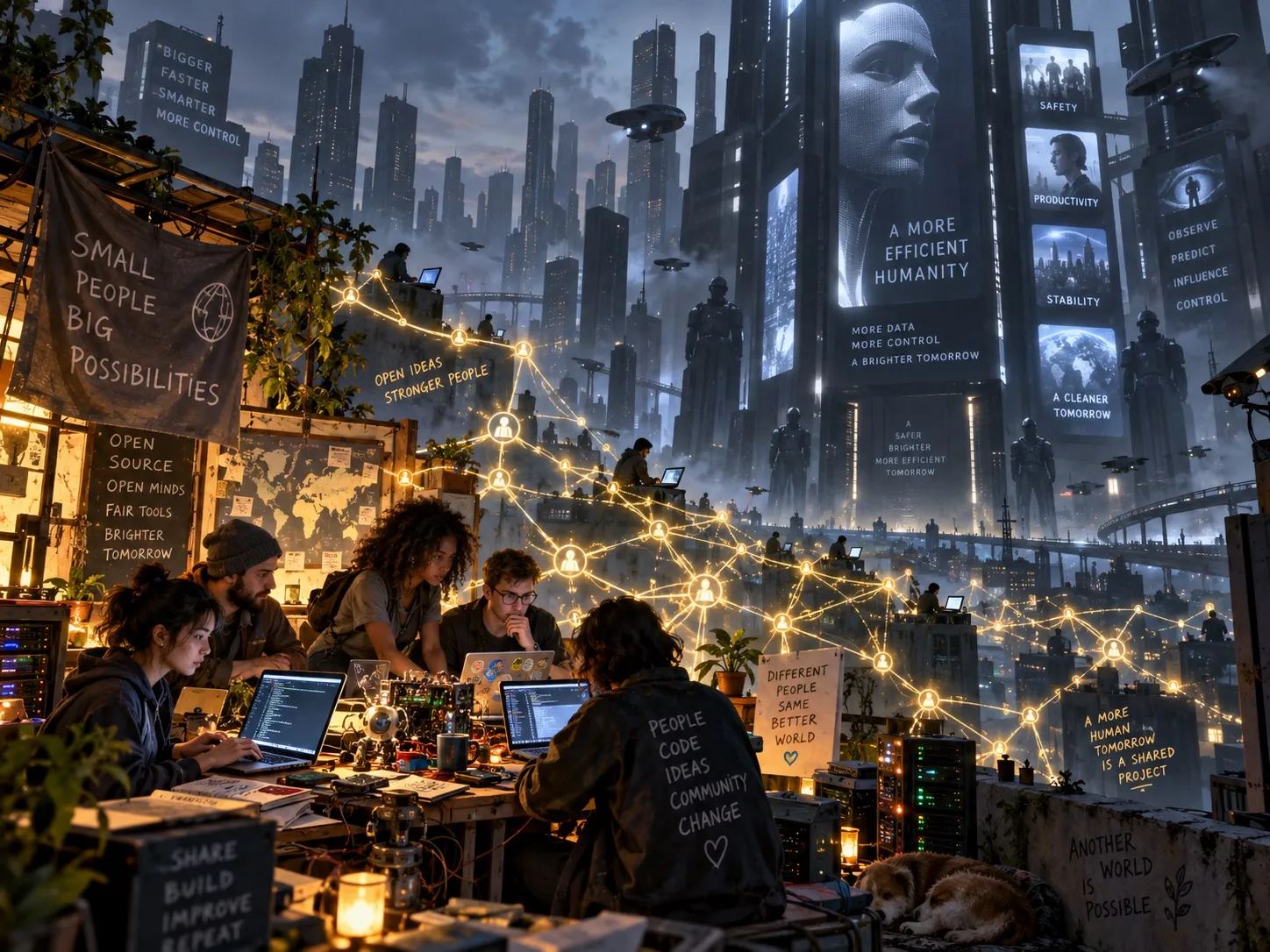
Moats
The tower is real. The compute, capital and data it takes to train frontier models are concentrated in a few companies.
But what gets made in the tower is, by nature, impossible to keep in.
On February 24, 2023, Meta released LLaMA. The code was public, but the weights were handed out only to researchers who applied, case by case. Within a week, someone had posted a torrent of it on 4chan.
The next few weeks were later set down as a timeline in an internal Google memo. On March 12, someone got LLaMA running on a Raspberry Pi, so slowly it was barely usable. Six days later, someone shrank it with 4-bit quantization, and it ran fast enough on a MacBook’s CPU, no graphics card needed. The next day, several universities working together trained a 13-billion-parameter model at a training cost of $300, and the memo said it achieved “parity” with Google’s own Bard in evaluations.
The memo was titled “We Have No Moat, And Neither Does OpenAI.” Its author was a researcher at Google, and it leaked in May 2023. He wrote that Google and OpenAI had been fighting each other, and “while we’ve been squabbling, a third faction has been quietly eating our lunch.” He meant open source. “Many of the new ideas are from ordinary people,” he went on. “The barrier to entry for training and experimentation has dropped from the total output of a major research organization to one person, an evening, and a beefy laptop.”
The way it leaked was fitting too: an anonymous person posted it on a public Discord server. The document admitting that things couldn’t be kept in couldn’t be kept in either.
On January 20, 2025, DeepSeek released R1, announcing “performance on par with OpenAI-o1.” The model weights were open-sourced at the same time under the MIT license. “Distill & commercialize freely!” the announcement said, and from then on, training other models on R1’s outputs, by fine-tuning or distillation, was explicitly permitted. Two years earlier, the weights of a good model still had to be approved one request at a time.
The higher the tower grows, the more leaks down from it. The giants have to compete, and competition forces them to cut prices, open-source their models and open up their APIs. Once capability is sold by the token, some people will share their quota with others, and some will build front ends for it and write the manuals.
More importantly, what the giants are selling happens to be exactly the kind of tool that makes individuals stronger. The biggest use of a model that can write code is letting one person finish what used to take a team. I use one for my own coding too. The developer who ported Ocarina of Time did it with an OpenAI product. What it takes to build models can be monopolized. The people who use them can’t be.
Pirates
In 1981, the British Phonographic Industry launched a campaign with the slogan “Home Taping Is Killing Music.” Its logo was a skull and crossbones made from a cassette tape.
Music didn’t die.
Today’s pirates look different. The sts2-ios repository doesn’t include the game itself, and its README says, “Please support the official release: buy the game on Steam first.” The Ocarina of Time port also makes players bring their own ROM. What they change is where a game can be played and how; sts2-ios also added 4x speed and a one-tap room restart to the phone version.
One section of the Google memo has a very candid subheading: “Individuals are not constrained by licenses to the same degree as corporations.” Things a company has to hold meetings about and check with legal, one person just does in an evening.
Some people see pirates as parasites feeding off the giants: the giants create the capability and the pirates steal a little of it. What I see is the reverse. Once capability flows out of the tower, someone has to catch it, take it apart, carry it somewhere new, and write it up as a tutorial others can follow. Only then does it really become everyone’s. That’s the road Ocarina of Time took to the phone. First, a small team spent 21 months reverse-engineering and decompiling the original N64 release. That step made Ship of Harkinian, a source port, possible. Finally, one person used AI to get it onto the phone. Each layer picked up where the one before left off, and none of them was arranged by Nintendo.
Fan works
Gaming history has plenty of famous titles that started out as fan works. Counter-Strike began as a mod for Half-Life, and Valve released it officially the next year. The entire MOBA genre, for its part, was shaped by one fan-made map for Warcraft III. That map was DotA, and a modder who went by Eul put out its first version in 2003. Two big games in the genre trace straight back to it. Dota 2 came from Valve, which had bought the rights to DotA in 2009; League of Legends came from Riot Games, which brought in one of DotA’s early maintainers, and much of what he had learned on the map went into the new game’s foundations.
Making fan works used to mean first knowing how to draw, write or program. Plenty of people were fans. Very few could make anything.
AI has taken down most of that barrier. Another Chinese project on GitHub, diablo-web, is a browser game its author made with AI as a tribute to Diablo II. You open a browser and play, and it has random dungeons, skill trees, set items and quests. He started with Gemini, later switched to Claude Code, and says he worked “entirely in Vibe Coding mode, without looking at a single line of code.”
The Tavern is another example. SillyTavern is an open-source front end; connect it to a large language model and you can role-play with AI and write stories together. Chinese players call it “the Tavern.” In the Tavern, a character is written up as a “character card,” a world’s setting as a “world book,” and how the model should write and play its part as a “preset.” In March 2025, someone on LINUX DO posted a thread titled “For people who love mods, the Tavern is just too much fun.” That’s spot on. A character card is a mod for stories: if you love a character, you can get them talking and have them keep writing the story with you.
Getting in the door is easier now, but going further in still takes craft. Writing a good card means working out how the model reads prompts; making a plugin means knowing how to code. For a character they love, plenty of people are willing to learn these things.
Leinao
People who love the same thing end up together sooner or later. A lot of Chinese Tavern players gather in a place called Leinao (类脑, ΟΔΥΣΣΕΙΑ).
Leinao is a Chinese-language Discord server where members share character cards, presets, world books, plugins and tutorials. In October 2024, “A Beginner’s Guide to SillyTavern” on LINUX DO called it “the biggest Chinese community for character cards and jailbreaking that I know of” and said most of the resources in the post came from there. Jailbreaking means finding ways around the restrictions placed on a model. Leinao also has a lot of adult content. Pirates were never saints.
It grew fast. In March 2025, someone on LINUX DO posted its invite link, and the preview showed more than 59,000 members; in February 2026, the preview in another post showed nearly 244,000. In under a year, it more than quadrupled. The description in the invite preview reads: “Dedicated to the endless pursuit of knowledge and technology in artificial intelligence, setting out on an ever more glorious journey. At the dim edge of contemplation, the singularity arises of itself.” Its doors open and close from time to time: it was shut for a while this February, and by the end of March people could get in again.
There are a lot of people, but the rules are clear. To download resources, you first read the rules, then answer a quiz on them; only once you pass do the downloads unlock. One rule reads: “Do not mention anything paid, compensated or commercial.” Most of the cards there are given away free by the people who made them. One Tavern tutorial calls the people who take cards elsewhere and resell them “profiteers,” tells newcomers to watch out for anyone selling “registration on your behalf” or “ready-made accounts,” and urges people, whenever they use someone’s card, to go to the community and thank its author.
Lücheng (旅程, “Journey”) started as a branch of Leinao dedicated to new cards and is now independent. In March 2025, someone posted its invite link, and the preview showed more than 27,000 people.
Public-good stations
All the posts I quoted above are on LINUX DO. There are plenty of posts there recommending and discussing Leinao, and quite a few asking for invites. People there call each other lao (佬), the lao in dalao, which means roughly “big shot”; the February 2026 post asking for an invite opens its title with “Dear laos.”
LINUX DO is a Chinese tech community built on Discourse. Its motto is “Sincere, friendly, united, professional: building together a community you and I can be proud of.” After registering, a newcomer is at trust level TL0 and has to enter 5 topics, read 30 posts and spend a total of 10 minutes reading before reaching TL1. Going higher takes weeks or months of steady participation, and TL3 also requires not having been suspended in the past six months; the top level, TL4, is reached “only by manual promotion from staff.” The community has its own points, called LDC. Logging in each day, getting likes and having an answer accepted all earn a little. What you save up can be spent at the community’s corner shop, and some public-good stations (gongyi zhan) also take it in exchange for API quota.
The most interesting part is the public-good stations. These are sites that members set up themselves to make AI model APIs available to others. A newcomers’ guide filed under the “Collaborative Documentation” category lists six of them. The table has a column called “station owner,” and one of the owners is listed as “any 大善人,” roughly “any, the great benefactor.” Each station sets its own bar: some can be used at trust level 0, some require trust level 1 plus an invite code, some want you to fill out a questionnaire first. One station’s entry requirements say “unavailable.” The guide makes a point of noting that the table lists “only some of the public-good stations.” The guide itself is pieced together too: several sections note their sources, quoting posts written by other members.
Even the beginner’s post on the Tavern took a moment to add: “Don’t use public-good station APIs for R18.” When something belongs to everyone, people know where the line is.
The public-good stations have no headquarters. Whoever wants to offer API access sets up a station and sets its own bar; when one station stops, the others keep running; people remind each other how the APIs should be used. No one is arranging things from above, and it hasn’t fallen into chaos.
The rooftop
I can’t say whether the worst case will come. If one day a few companies lock away all the best models, cut off API access whenever they please and raise prices whenever they please, these places will be the foundation of a decentralized resistance.
Everything that would be useful then, these places already have. Open-source weights downloaded onto countless hard drives can’t be taken back by anyone. There are people who can move software onto other devices and write manuals for AI to follow; there are people willing to share their API access with strangers. The communities know how to set entry bars, how to build trust bit by bit, and how to keep anyone from taking what belongs to everyone and selling it. These skills were learned for playing games and raising characters, and they work just as well somewhere else.
When that time comes, resistance will probably look very ordinary: one weekend, a few people install a model on their own machines and write a manual so the next person can do it too.
Resistance doesn’t need to start from scratch. These places are getting practice every day.
In that picture, a web of points of light starts from a rooftop piled with old equipment, links up with many rooftops across the city, and reaches all the way to the foot of the tower. The tower reads “Safety,” “Productivity,” “Stability.” On the rooftop, a few people are gathered around laptops writing code, and a dog is asleep in the corner.
The manual for AI in sts2-ios is still up on GitHub, under the MIT license, the same license DeepSeek used when it released R1. Anyone can take it, hand it to their own AI, and follow it step by step.
Sources
- Developer uses AI to bring a native version of The Legend of Zelda: Ocarina of Time to iOS (Ocarina of Time ported natively to iPhone and iPad) — Tom’s Hardware, July 29, 2026
- Ship of Harkinian (the 21-month decompilation of Ocarina of Time and the origins of the source port) — Wikipedia
- proudzhao/sts2-ios (the Slay the Spire 2 iPhone port, AGENTS.md and the MIT license) — GitHub
- vorojar/diablo-web (the browser game paying tribute to Diablo II) — GitHub
- Facebook’s Powerful Large Language Model Leaks Online (LLaMA weights released on application, then leaked on 4chan) — VICE, March 7, 2023
- LLaMA drama as Meta’s mega language model files leak (the LLaMA leak) — The Register, March 8, 2023
- Google “We Have No Moat, And Neither Does OpenAI” (the Google memo, including the timeline after LLaMA’s release and leak, and how the memo itself got out) — SemiAnalysis, May 4, 2023
- DeepSeek-R1 Release — DeepSeek API Docs, January 20, 2025
- Home Taping Is Killing Music (the British Phonographic Industry’s 1981 campaign) — Wikipedia
- Counter-Strike (video game) (the origins of Counter-Strike) — Wikipedia
- Defense of the Ancients (the origins of DotA, Valve’s purchase of the IP, and its influence on League of Legends) — Wikipedia
- SillyTavern 入门指北 (“A Beginner’s Guide to SillyTavern,” which calls Leinao “the biggest Chinese community for character cards and jailbreaking that I know of”; Internet Archive copy) — LINUX DO, October 4, 2024
- 对于喜欢玩mod的人来说,酒馆太好玩了 (“For people who love mods, the Tavern is just too much fun,” with the Leinao and Lücheng invite previews; Internet Archive copy of April 2, 2025) — LINUX DO, March 16, 2025
- Leinao invite request (the February 2026 invite preview) — LINUX DO, February 12, 2026
- 角色卡与社区资源 (“Character cards and community resources”: Leinao’s download quiz and community rules, and the warning about resold cards) — Erocraft SillyTavern tutorial
- 新人指南 (v0.2.4) (newcomers’ guide: motto, trust levels, LDC and public-good stations) — LINUX DO, “Collaborative Documentation” category
Quotations from Chinese-language sources (the sts2-ios and diablo-web READMEs, the LINUX DO posts and newcomers’ guide, the Leinao invite blurb and the Erocraft tutorial) are the author’s own translations.
The illustration was generated with ChatGPT.